Set Theory
Set Theory is a branch of mathematics in which we study about sets and their properties.
Georg Cantor (1845-1918), a German mathematician, initiated the concept ‘Theory of sets’ or ‘Set Theory’. He was working on “Problems on Trigonometric Series” when he encountered something that had become the most fundamental thing in mathematics. Set theory is the fundamental theory in mathematics. Without sets, it is not possible to explain relations, functions, sequences, probability, geometry etc. Apart from this, Cantor also conceptualized that some of the infinities are countable and others are uncountable. He introduced the fact that the uncountable infinite set of real numbers is larger than the countable infinite set of integers. This is known as Cantor’s diagonal argument.
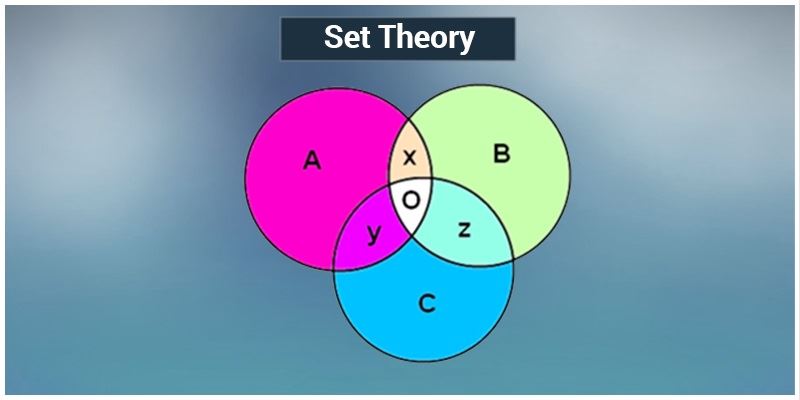
Let us now go ahead and learn the meaning of sets in maths.
Sets:
To understand sets, consider a practical scenario. While going to school from home, Nivy decided to note down the names of restaurants which come in between. The list of the restaurants, in the order they came, was:
The above mentioned list is a collection of objects. Also, it is well-defined. By well-defined, it is meant that anyone should be able to tell whether the object belongs to the particular collection or not. E. g. a stationary shop can’t come in the category of the restaurants. If collection of objects is well-defined, it is known as a set.
The objects in a set are referred as elements of the set. A set can have finite or infinite elements. While coming back from the school, Nivy wanted to confirm the list what she had made earlier. This time again, she wrote the list in the order in which restaurants came. The new list was:
Now, this is a different list. But is a different set? The answer is no. The order of elements has no significance in sets so it is still the same set. In mathematics, we follow some rules for representation of sets. The rules are:
- The name of the set is denoted by upper case alphabet letters.
- The elements or members or objects of the set are denoted by lower case alphabet letters.
- If
′a′ belongs to A , this is represented as a∈A . Here, ∈ is a Greek symbol, called epsilon. ∈ denotes “belongs to”. If ′c′ doesn’t belong to set A, we write it as c∉A .
If RE R
Similarly, to show that stationary shop SA R
Sets can be represented in two ways:
- Roster or Tabular Form: In this form, all the elements of the set are listed, separated by commas and enclosed between curly braces { }. E.g. If set represents all the leap years between year 1995 and 2015, then it would be described using Roster form as:
Now, the elements inside the braces are written in ascending order. This could be descending order or any random order. As discussed before, order doesn’t matter for a set represented in the Roster form. Also, multiplicity is ignored while representing the sets. E.g. If L
- Set-builder Form: In this form, all the elements have a common property. This property is not applicable for the objects that do not belong to the set. E.g. If set
S has all the elements which are even prime numbers, it is represented as:
where x
‘:’ means ‘such that’
‘{}’ means ‘the set of all’
So, S x:x is an even prime number S 2
To quote an another example, if F p: p is a 2−digit perfect square number F
There are several symbols that are adopted for common sets. They are given in the table below:
Table 1: Symbols denoting common sets
| Symbol | Corresponding Set |
| N | · Represents the set of all Natural numbers i.e. all the positive integers.
· This can also be represented by
· Examples: 9, 13, 906, 607, etc.
|
| Z | · Represents the set of all integers
· The symbol is derived from the German word Zahl, which means number.
· Positive and negative integers are denoted by
· Examples: -12, 0, 23045, etc.
|
| Q | · Represents the set of Rational numbers
· The symbol is derived from the word Quotient. It is defined as the quotient of two integers (with non-zero denominator)
· Positive and negative rational numbers are denoted by
· Examples:
|
| R | · Represents the Real numbers i.e. all the numbers located on the number line.
· Positive and negative real numbers are denoted by
· Examples:
|
| C | · Represents the set of Complex numbers.
· Examples: 4 + 3i, i, etc.
|
Sets are used to describe one of the most important concepts in mathematics i.e. functions. Everything what you observe around you, is achieved with mathematical models which are formulated, interpreted and solved by functions. To learn more about these interesting concepts, visit www.byjus.com. To watch videos and understand the concepts, download Byju’s-The Learning App from Google Play Store.
Comments
Post a Comment