
Co-ordinate

Co-ordinate

Coordinate Geometry is considered to be one of the interesting concepts of Mathematics. Coordinate Geometry describes the link between geometry and algebra through graphs involving curves and lines. It provides geometric aspects in Algebra and enables to solve geometric problems. It is a part of geometry where the position of points on the plane is described using an ordered pair of numbers.

What is a Co-ordinate and a Co-ordinate Plane?

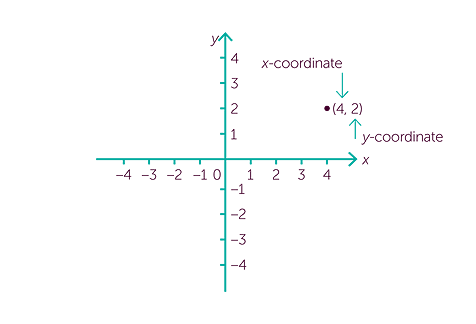
You must be familiar with plotting graphs on a plane from the tables of numbers for both linear and nonlinear equations. The number line which is also known as a Cartesian plane is divided into four quadrants by two axes perpendicular to each other, labeled as the x-axis (horizontal) and the y-axis(vertical line).
The four quadrants along with their respective values are represented in the graph below-
Quadrant 1 : (+x, +y)
Quadrant 2 : (-x, +y)
Quadrant 3 : (-x, -y)
Quadrant 4 : (+x, -y)
The point at which the axes intersect is known as the origin. The location of any point on a plane is expressed by a pair of values (x, y) and these pairs are known as the coordinates.
The figure below shows the Cartesian plane with coordinates (4,2). If the coordinates are identified, the distance between the two points and the interval’s midpoint that is connecting the points can be computed.
Geometry

Distance Between two Points

Let the two points be A and B, having coordinates to be (x1,y1) and (x2,y2) respectively.
Thus, the distance between two points is given as-
d=(x2x1)2+(y2y1)2

Midpoint of a line connecting two points:

Consider the same points A and B, having coordinates to be (x1,y1) and (x2,y2) respectively. Let M(x,y) be the midpoint of lying on the line connecting these two points A and B. The coordinates of the point M is given as-
M(x,y)=(x1+x22,y1+y22)
Equation of a Line- Equation of a line can be represented in many ways, few of which is given below-
(i) General form- The general form of a line is given as Ax + By + C = 0.
(ii) Slope intercept form- Let x,y be the coordinate of a point through which a line passes, m be the slope of a line, and c be the y-intercept, then the equation of a line is given as-
y=mx+c
(iii) Intercept form of a line- Consider a and b be the x-intercept and y-intercept respectively, of a line, then the equation of a line is represented as-
xa+yb=1
Slope of a line- Consider the general form of a line Ax + By + C = 0, the slope can be found by converting this form to the slope intercept form.
Ax+By+C=0
By=AxC
or y=ABxCB
Comparing the above equation with y = mx + c,
m=AB
Thus we can directly find the slope of a line from the general equation of a line.
Angle between two lines-
Consider two lines A and B, having their slopes to be m1 & m2 respectively.
Let θ be the angle between these two lines, then the angle between them can be represented as-
tanθ=m1m21+m1m2
Special Cases-
Case 1- When the two lines are parallel to each other,
m1=m2 = m
Substituting the value in the equation above,
tanθ=mm1+m2=0
θ=0
Case 2- When the two lines are perpendicular to each other,
m1.m2=1
Substituting the value in the original equation,
tanθ=m1m21+(1)=m1m20 which is undefined.
θ=90
Section Formula-
Consider a line A and B having coordinates (x1,y1) & (x2,y2) respectively. Let P be a point that which divides the line in the ratio m:n, then the coordinates of the coordinates of the point P is given as-
(i) When the ratio m:n is internally-
(mx2+nx1m+n,my2+ny1m+n)
(ii) When the ratio m:n is externally-
(mx2nx1mn,my2ny1mn)
Students can follow the link provided to learn the proof for the section formula.
Examples- Find the distance between the points M (4,5) and N (-3,8).
Solution- Applying the distance formula we have,
d=(34)2+(85)2
d=(7)2+(3)2=49+9
d=58
Example- Find the equation of a line parallel to 3x+4y = 5 and passing through points (1,1).
Solution- For a line parallel to the given line, the slope will be of the same magnitude.
Thus the equation of a line will be represented as 3x+4y=k
Substituting the given points in this new equation, we have
k=3×1+4×1=3+4=7
Therefore the equation is 3x+4y=7

Area of a triangle:
The area of the triangle whose vertices are (x1,y1),(x2,y2) and (x3,y3) is
12|x1(y2  y3) + x2(y3  y1) + x3(y1  y2)|
If the area of a triangle whose vertices are (x1,y1),(x2,y2) and (x3,y3) is zero, then the three points are collinear.
For detailed, chapter wise solutions for NCERT questions, students can compare their answers with NCERT sample answers given here by Byju’s –NCERT Solutions
Click here to Download Co-ordinate Geometry pdf

Comments

Popular posts from this blog

SSC Practice Problem Solution

SSC Practice Problem Solution In this post, we will discuss solution of  SSC Practice Problem . Question 1  The efficiency of (A + B) = 100/24 = (25/6)% The efficiency of (A + B + C) = 100/8 = (25/2)% The efficiency of C = 25/2 – 25/6 = (50/6)% Hence, C can alone finish this job in = 100/(50/6) = 12 days Answer: 12 days option (1) Question 2  Original price = Rs. 6000; Price after discount = 6000 – 1200 = Rs. 4800; Price after raising service contract = 4800 + 480 = Rs. 5280 Answer: Rs. 5280 option (2) Question 3  Suppose the received money by A, B, and C is respectively 5x, 6x, and 9x. 5x = 450; => x = 90; Hence, the total money = 20x = 20*90 = Rs. 1800; Answer: Rs. 1800 option (2) Question 4 Suppose the Cost price of the bag= Rs. x; Hence, x + 0.15x = 230; => x = Rs. 200; Selling price after selling on 20% = 200 + 20% of 200 = Rs. 240 Answer: Rs. 240 option (3) Question 5  The required percentage ...

Average

Average In this post, We will learn about average.  Average of any collection of data is the sum of data divide by number of data. Average = (Sum of observations /  Number of observations) Please write comments if you find anything incorrect, or you want to share more information about the topic discussed above.  problems The arithmetic mean of x, y and z is 80, and that of x, y, z, u and v is 75, where u=(x+y)/2 and v=(y+z)/2. If x ≥ z, then the minimum possible value of x is (CAT 2018) As specified in the question mean of x and y and z is 80 x+y+z=3*80 mean of x, y, z,u,v is 75 x+y+z+u+v=75*5 2u=x+y 2v=y+z x+y+z+((x+y+y+z)/2)=75*5 y+3(x+y+z)=75*10 y=750-720 y=30 since x+y+z=240 y=30 so x+z=210 since x>=z so minimum value of x=210/2 = 105 Problem2: In first 5 inings sehwag has scored at average of 40. In sixth ining He had scored 52 what is His average after 6th ining. one simple approach is getting total score divided by no of inin...

Complex Number

Complex Number While solving the equation of the form  a x 2 + b x + c = 0 , the roots of the equations can take three forms which are as follows: Two Distinct Real Roots Similar Root No Real roots (Complex Roots) The introduction of complex numbers in the 16th century made it possible to solve the equation  x 2 + 1 = 0 . The roots of the equation are of the form  x = ± − 1 ‾ ‾ ‾ √  and no real roots exist. Thus, with the introduction of complex numbers, we have Imaginary roots. We denote  − 1 ‾ ‾ ‾ √  with the symbol i, where i denotes Iota (Imaginary number). An equation of the form z= a+ib, where a and b are real numbers, is defined to be a complex number. The real part is denoted by Re z = a and the imaginary part is denoted by Im z = b. Algebraic Operation on Complex numbers: Addition of two complex numbers Subtraction of two complex number Multiplication of two complex number Division of two complex number Power of Iota (i) ...

Logarithm

Logarithm When a x   = N , then we say that x = logarithm of N to the base a and write it as x = log a N . In simple words, it represents the power to which a number must be raised. Let me expand on that by giving a simpler example. If we are asked, what would be the result if ‘a’ is multiplied with itself ‘b’ times; then your answer would be x = a*a*a*…. b (times). This can also be written as a^b. This is also known as ‘a raised to the power of b’ If we are asked, which number multiplied with itself ‘b’ times, will result in a; then you are asked for the value of x such that x*x*x*… b(times) = a => x^b = a => x = a^(1/b) This is also known as ‘bth root of a’ If swe are asked, how many times should you multiply ‘a’ with itself to get ‘b’, that is where the concept of logarithm comes into the picture. You are asked for the value of ‘x’ such that a*a*a…. x (times) = b => x = Log  a  b This is also known as ‘ Log b to the base a’ ...